January is designated as Poverty Awareness Month, a month to recognize and combat poverty in America. The origins of Poverty Awareness Month date back to President Lyndon Johnson’s War on Poverty in 1965,1 and January was reintroduced as Poverty Awareness Month by the House of Representatives in 2009.2
Low-income households in the central Puget Sound region are significantly more likely to rely on public transit and to live without access to a personal vehicle, compared to their higher-income neighbors.3 This makes it crucial for PSRC to address the needs of low-income individuals and families in the context of transportation planning.
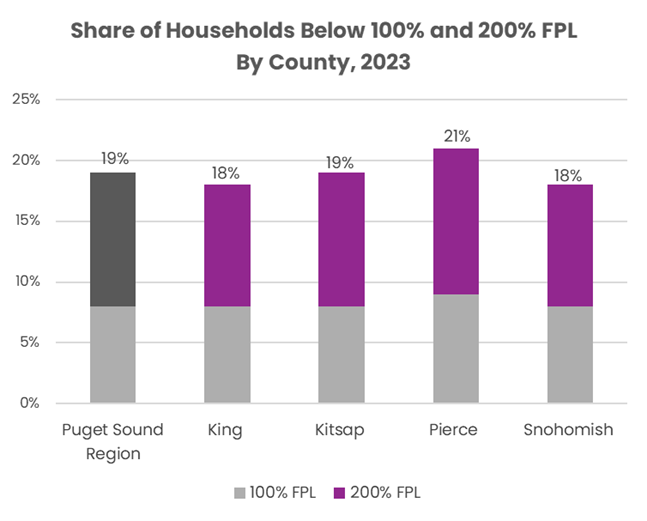
Source: U.S. Census Bureau, American Community Survey, 2023 5-Year Estimates, Table C17002
The U.S. Department of Health and Human Services recommends 100% of the Federal Poverty Line (FPL) as a baseline to define low-income populations. The PSRC defines low-income as earning below 200% of the FPL, due to the region’s high cost of living and consistency with local reduced fare programs.
Households with low incomes in the region could include a single parent working in food preparation making $40,545 a year; a family of four with one working person making $42,955 a year, another person living on Social Security disability, with two children; or a senior living on Social Security and aging in place.
Across the region, youth ages 5-17 and adults over the age of 65 are more likely to live in low-income households, compared to the region as a whole. Similarly, individuals living with a disability are twice as likely to be in a low-income household, compared to those without a disability.4 In the region, disparities can also be seen along racial and gender lines. People of color, women of color in particular, are more likely to live in a low-income household than white people.5 Individuals with limited English proficiency are also more likely to live in low-income households.6
As we honor Poverty Awareness Month, PSRC remains committed to serving low-income individuals and households by engaging community members to better understand their transportation needs and incorporate them into the Regional Transportation Plan. The Draft Regional Transportation Plan 2026-2050 prioritizes accessibility for all residents, including low-income individuals and households. Findings from outreach, surveys, and public engagement efforts can be found in the draft Regional Transportation Plan and Coordinated Mobility Plan posted on the Engagement Hub for public comment by February 2.
1 Community Action Partnership, (2025), National Poverty Awareness Month. https://communityactionpartnership.com/poverty-awareness-month/
2 H.Res.1024. 111th Congress (2010). https://www.congress.gov/bill/111th-congress/house-resolution/1024
3 Puget Sound Regional Council, Household Travel Survey, 2023
4 U.S. Census Bureau, 2019-2023 American Community Survey 5-Year Public Use Microdata Sample
5 U.S. Census Bureau, 2019-2023 American Community Survey 5-Year Public Use Microdata Sample
6 U.S. Census Bureau, 2023 American Community Survey 5-Year PUMS