
PSRC celebrates Black History Month and Transit Equity Day by honoring Rosa Parks and the importance of equitable access to transportation. Black History Month was first established in 1926 to promote the achievements of Black communities during February.1
Transit Equity Day is observed on Rosa Parks’ birthday every February 4. Rosa Parks was a civil rights activist who spent her life advocating for equal rights. In 1955, Parks was arrested for refusing to give up her seat on a bus to a white man.2 Her arrest triggered the Montgomery Bus boycott that lasted 381 days and played a significant role in the civil rights movement of the 1950s and 1960s.3
Today, in the central Puget Sound, about 6 percent of the population are Black or African American residents, representing the top five racial and ethnic groups, following non-Hispanic White, Asian, Hispanic, and individuals representing two or more races.4 However, Black or African American residents are overrepresented in transit usage. The 2023 PSRC Household Travel Survey highlights:
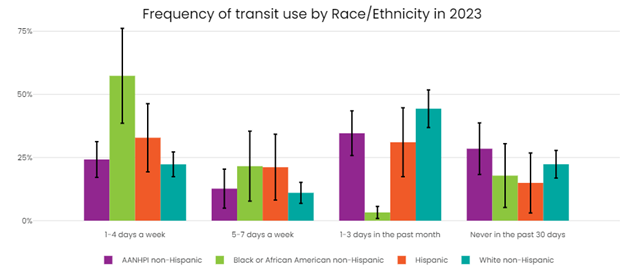
- Black or African American individuals are more likely than Asian American, Native Hawaiian, and Pacific Islander, Hispanic, and non-Hispanic White riders to regularly use public transportation.
- Over half of Black or African American riders use transit 1-4 days a week and 22 percent use 5-7 days a week. By comparison, regionwide, 28 percent ride transit 1-4 days a week and 13 percent use transit 5-7 days a week.
- Among all racial and ethnic groups, Black or African American individuals have the highest share of walking and biking at 16 percent, compared to 11 percent regionwide.
- While driving is the most preferred mode of travel across all groups, Black or African American individuals have the lowest driving rate compared to other races/ethnicities, which limits access to essential services or travel during off-peak hours.
PSRC’s Current System Report shows smaller gaps in local and frequent transit in areas with higher shares of people of color. However, the availability of transit alone does not represent the true “access” to transportation or equity in mobility. Some communities still experience longer travel times and unreliable transfers or connections to reach day-to-day destinations. Furthermore, the legacy of structural racism, which has created significant wealth and income disparities, makes these issues even worse as Black or African American residents are disproportionately displaced from their homes, pushed further from their jobs, and forced to endure even longer commutes.
These disparities are further reflected in PSRC’s Regional Safety Action Plan. The plan highlights that communities with higher proportions of people of color experience 32 percent higher rates of serious injuries and deaths compared to the region as a whole.
Black-African American communities have long advocated for more reliable transit, safer streets, and improved access to opportunities. Exploring these disparities helps the region understand and develop strategies to improve the quality of life for all. The next Regional Transportation Plan, addressing regional priorities for future transit, sidewalks, bicycle lanes and safety improvements, is scheduled for adoption in May. Additionally, PSRC’s Regional Equity Strategy and other efforts can be found on our Equity page.
1 The Association for the Study of African American Life and History (2026), The Origins of Black History Month. https://asalh.org/about-us/origins-of-black-history-month/
2 National Archives (2016), An Act of Courage, The Arrest Records of Rosa Parks. https://www.archives.gov/education/lessons/rosa-parks
3 Ibid.
4 U.S. Census Bureau, American Community Survey, 2023 1-Year Estimates, Table B03002