
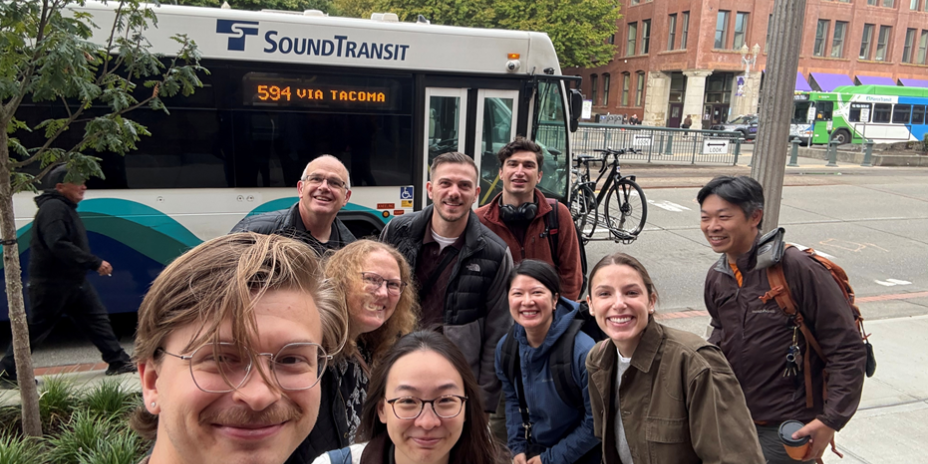
The beginning of October (September 29 – October 2) marked the Week Without Driving! Participants ditched their automobiles to walk, train or bus around the region.
America Walks and Disability Rights Washington asked residents to find alternative transportation methods for their Week Without Driving challenge. The purpose of the challenge is to help drivers understand how people who do not have access to a car get around the region, and to learn first-hand the barriers and difficulties nondrivers face.
Week Without Driving was launched in 2021 by Anna Zivarts at Disability Rights Washington to highlight how people with disabilities travel and the different ways we can make transportation and communities more accessible.
PSRC staff participated this year and shared their car-free experience.
Casey Moreau, Administrative Policy Analyst
“I'm thankful for our flexible work policy and employer-provided ORCA card—it makes it easy to skip the commute, take transit or bike when going to the office. Seattle’s improved biking infrastructure has made cycling a fun and practical option for commuting, running quick errands, and even joining agency group rides.”
Eric Clute, Associate Planner
“Well, I don’t own a car, so it was really business as usual. This week I took a couple 12-mile (round trip) bike rides to Ballard to meet up with friends. Better bike lanes are making these trips safer and more enjoyable, while also reducing my carbon footprint (basically to zero!). I’ve also been commuting to Tacoma by bus, which has been a new experience for me. Easy connections but I do wish they were faster. Driving would have taken half the time. Overall, it’s nice taking transit since I can catch up on my email or watch YouTube. Much less stressful than white-knuckling it down I-5!”
Allie Perez, Associate Communications Specialist
“I relied on walking for all of my easier access trips (to the grocery store, to get coffee) which was really nice to get outside, but that method depends on my ability, the sidewalk and crosswalk infrastructure safety, and my proximity to walkable shops. I used public transit and carpooling for longer journeys which worked great — up until I needed to go to the ER and wasn’t well enough to wait and ride a bus, or to attempt the long walk to the hospital. Without my household’s car, I would’ve needed to ask one of my friends for a ride, which would depend on their schedules and availability and add to the delay in care, or I would've had to pay for a rideshare/taxi service since I didn’t warrant an ambulance or emergency transportation. I am so lucky to have had the ability to drive to the hospital in a timely manner but without my car it would’ve proven very difficult, added to the already stressful situation, and delayed my healthcare further, worsening my experience/symptoms.”
Piset Kuhon, Principal IT Specialist
“Great reminder of how advantageous living in the city is when a car is not nearby: I could walk to the bank, grocery store, bike to work, transit to Tacoma. But also, how difficult it is when transit is the only option: Fewer transit running off peak hours, timing transfer connections, or what to do when forget to bring your keycard, or the bus shows up late. There is still much to be done, but compared to when I moved here in 1998, things have gotten better.”
During a Week Without Driving, staff questioned how the region’s current transportation systems can improve. PSRC is developing a new Regional Transportation Plan (RTP) that aims to fill gaps in our transit networks. We are looking for community input! Visit our engagement hub to learn more about the RTP and leave a comment.