
PSRC is honoring Women’s History Month in March, which was signed into law in 1987 to recognize women’s contributions to the nation’s history. This year’s theme, “Leading the Change: Women Shaping a Sustainable Future,” highlights women’s powerful leadership in building a future rooted in opportunity for all.[1]
Women often have distinct travel patterns and face transportation barriers, including limited accessibility, availability, and safety concerns. These barriers can disproportionately affect women’s ability to access jobs, education, healthcare, and other essential services.[2]
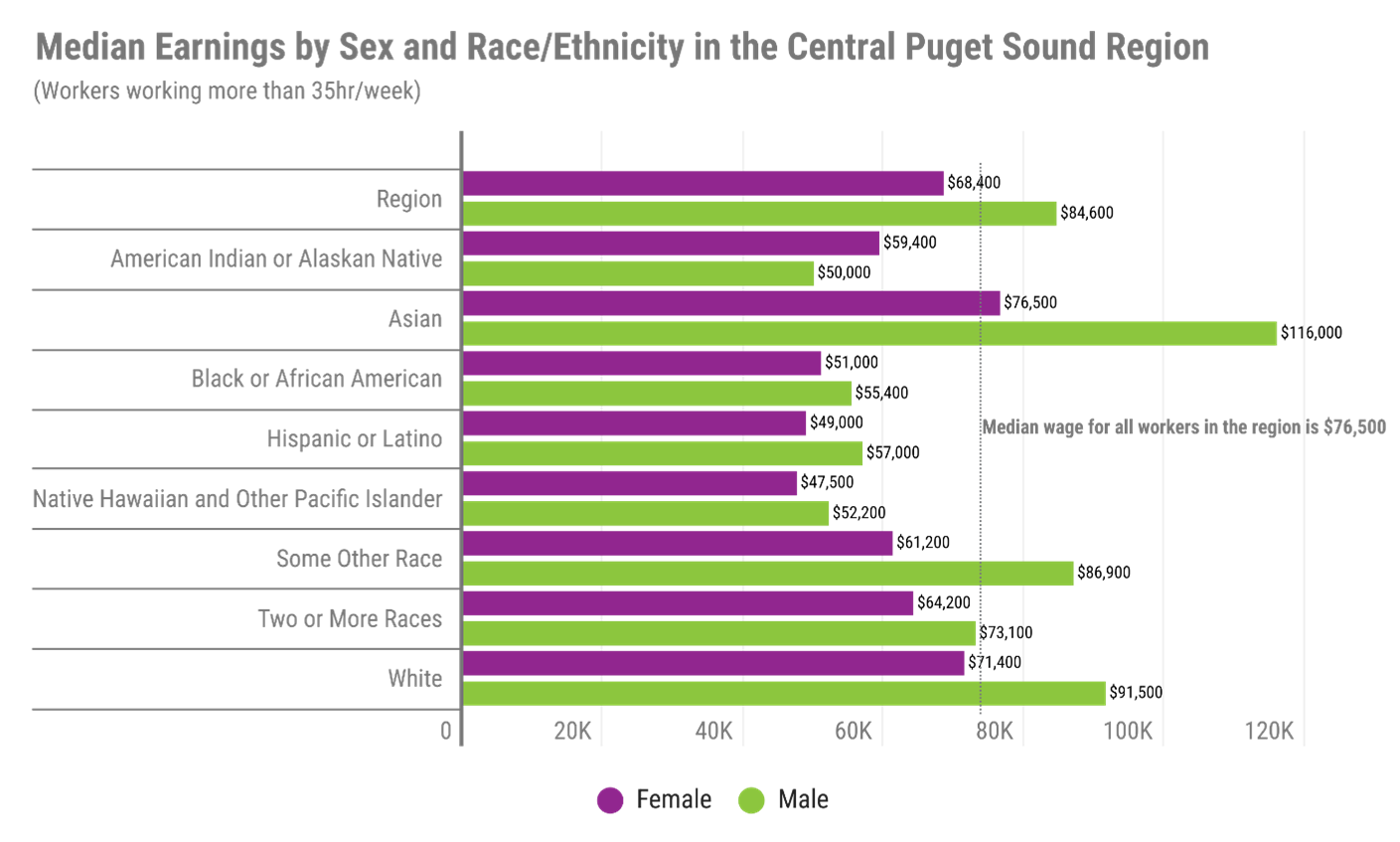
Source: U.S. Census Bureau, 2019-2023 American Community Survey (ACS), 5-Year Public Use Microdata Sample (PUMS) data
In the central Puget Sound region, women make up about half of the population and represent 41% of full-time workers.[3] The median wage for women in the region ($68,400 per year) is approximately $16,000 lower than the median wage for men ($84,600 per year). The wage disparities are even greater for some racial groups. Women identifying as Hispanic, American Indian or Alaskan Native, Black, and Pacific Islander, on average, earn less than $68,400, the regional median wage for all women who work full-time.[4] While Asian and White women earn above that threshold, they still earn far less than men in those respective groups.[5]
Differences in types of jobs held by men and women are another major contributor to wage disparities and shape women’s unique transportation needs. In the region, women are underrepresented in the highest-paying jobs (e.g., computer and mathematical sectors and architecture and engineering), and overrepresented in lower-paying jobs (e.g., healthcare support, personal care and service, and community and social services). [6]
Despite the relatively high cost of owning and maintaining a vehicle, a higher share of women drive compared to men in central Puget Sound, while a higher share of men ride transit, walk or bike.[7] One reason is the limited public transportation options during non-peak hours. Many lower-paying jobs require work early morning, evening, or during other non-peak work hours, when transit is less frequent and available.[8] In addition, differences in travel purpose also contribute to women’s greater reliance on driving. In the region, a larger share of women’s trips is for non-work activities, including social or recreation, running errands, shopping, and escorting family members and friends, while a higher share of men’s trips is work- and school-related.[9] Non-work activities often take place outside traditional peak hours and involve multiple stops, making them more difficult to complete riding transit, walking or biking.
Access to economic opportunities and a more affordable and reliable transportation is crucial for everyone, but especially for women, who often face unique barriers and challenges. Through the Coordinated Mobility Plan, PSRC identified transportation priorities that could help address these barriers and challenges, such as shorter wait times and more reliable transfers and return trips, and a more frequent and expanded transit service, especially during evenings, weekends and other times when people need it most. PSRC is working with member jurisdictions and partners across the region to address these challenges and improve access to opportunity for all.
[1] National Women’s History Alliance (NWHA). Leading the Change: Women Shaping a Sustainable Future (2026). Retrieved from: https://nationalwomenshistoryalliance.org/womens-history-theme-2026/
[2] World Bank Group. Closing Gender Gaps in Transport. (2025, July 18). Retrieved from: www.worldbank.org/en/topic/transport/brief/closing-gender-gaps-in-transport.
[3] U.S. Census Bureau. 2019-2023 American Community Survey (ACS). 5-Year Public Use Microdata Sample (PUMS)
[4] While earnings between men and women identifying as American Indian, Alaska Native, Black, and Native Hawaiian and Pacific Islander appear more comparable, these estimates rely on relatively small sample sizes, which can make the results less reliable.
[5] U.S. Census Bureau. 2019-2023 ACS. 5-Year PUMS.
[6] It is noted that while there may be a range of earnings within the same occupation, women workers in the highest-paying occupation may not earn as much as men in the same occupation.
[7] Puget Sound Regional Council. 2017-2023 Household Travel Survey
[8] Urban Institute. Transportation Access. (2021). Retrieved from: Transportation access | Urban Institute | Upward Mobility Initiative
[9] Ibid.